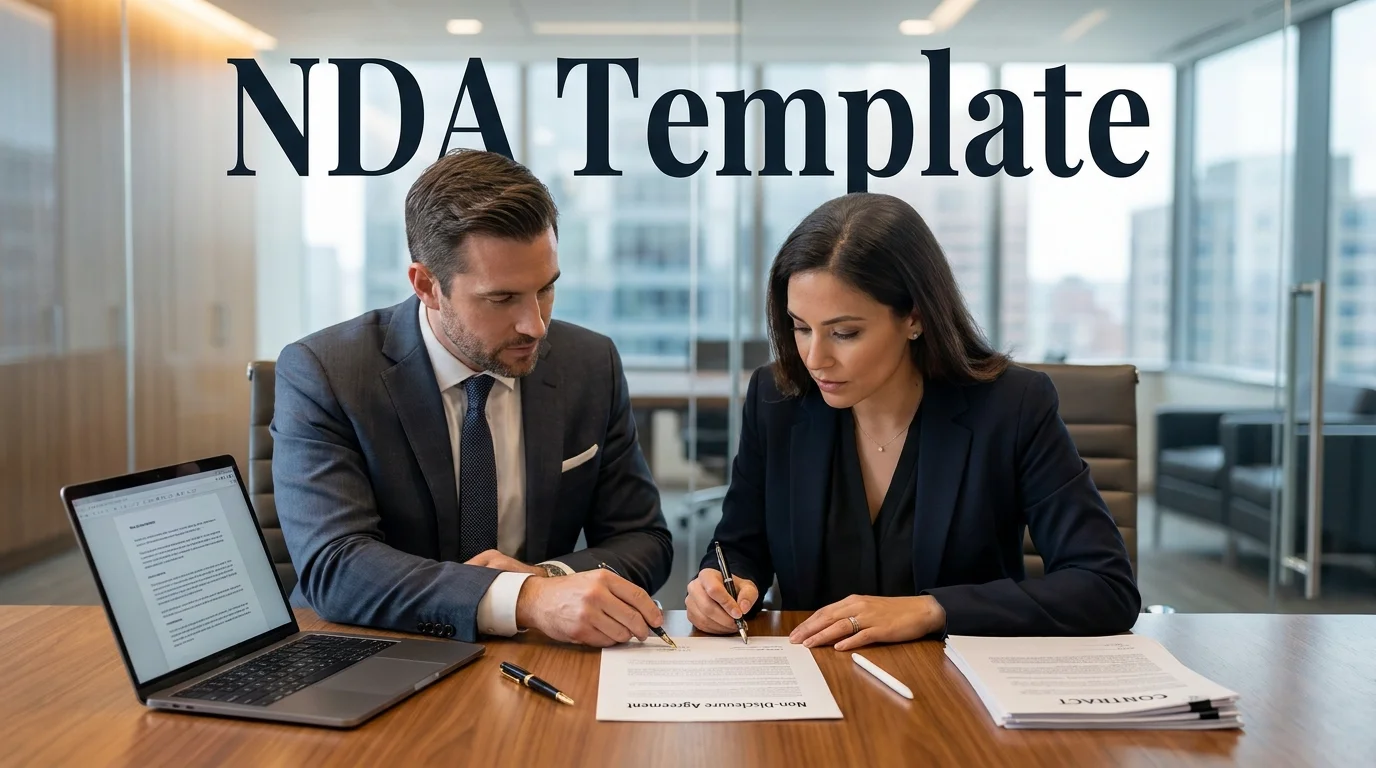
If you need an NDA template for a U.S. business relationship, you can start with the free general-purpose sample below and customize it for your deal. The sample costs $0 to copy and covers the core terms commonly used to protect confidential business information. Because contract and employment rules vary by state and situation, legal review may still be appropriate before signing.
| Key point | What to know |
|---|---|
| Cost of this sample | $0 to copy and customize |
| Best for | Business discussions, contractors, vendors, partnerships, and due diligence |
| Agreement type | Can be adapted as one-way or mutual |
| Main purpose | Limit unauthorized use or disclosure of confidential information |
| Governing law | Choose the applicable U.S. state |
| Signatures | Identify and sign for every party that will be bound |
| Legal review | Recommended when valuable IP, employees, disputes, or state-specific rules are involved |
A U.S. confidentiality agreement should identify the parties, define confidential information, explain permitted use, list exclusions, set a reasonable term, choose governing law, and provide signatures. Use a one-way form when only one side discloses secrets, or a mutual form when both sides share protected information. State-specific review may still be needed.
Key Takeaways
- Define protected information clearly instead of calling everything confidential.
- State exactly why the receiving party may use the information.
- Exclude information that is public, independently developed, or lawfully obtained elsewhere.
- Choose between a one-way and mutual agreement based on who will disclose information.
- Set a confidentiality period that fits the information and business relationship.
- Check additional federal and state rules before using confidentiality terms with workers.
Free U.S. Non-Disclosure Agreement Sample
A basic NDA can protect business plans, customer information, pricing, software details, product plans, financial data, and other nonpublic material. The agreement should connect that information to a specific business purpose rather than impose an unlimited secrecy obligation. It should also explain what happens when information becomes public or must be disclosed by law.
NON-DISCLOSURE AGREEMENT
Effective Date: [DATE]
Parties: This Non-Disclosure Agreement is entered into between [DISCLOSING PARTY NAME AND ADDRESS] and [RECEIVING PARTY NAME AND ADDRESS].
1. Purpose. The parties expect to discuss or work on [DESCRIBE BUSINESS PURPOSE]. Confidential information disclosed under this agreement may be used only for that purpose.
2. Confidential Information. “Confidential Information” means nonpublic business, technical, financial, commercial, customer, product, operational, or other information disclosed in writing, electronically, orally, or through inspection that is identified as confidential or reasonably should be understood as confidential.
3. Exclusions. Confidential Information does not include information that the receiving party can show was already lawfully known, becomes public without breach, is lawfully received from another source, or is independently developed without using the protected information.
4. Receiving Party Obligations. The receiving party will use reasonable care to protect Confidential Information, use it only for the stated purpose, and disclose it only to people who need access and are subject to appropriate confidentiality duties.
5. Required Disclosure. A party may disclose information when required by applicable law, court order, or lawful government process. Where legally permitted, the receiving party should provide reasonable notice so the disclosing party may seek appropriate protection.
6. Ownership. Disclosure does not transfer ownership of intellectual property, trade secrets, copyrights, patents, trademarks, or other rights unless the parties separately agree in writing.
7. Term. This agreement begins on the Effective Date and continues for [NUMBER] years. Confidentiality obligations will continue for [NUMBER] years after disclosure, except that qualifying trade secrets may receive protection for as long as applicable law recognizes them as trade secrets.
8. Return or Destruction. On written request, the receiving party will return or destroy protected materials, subject to lawful record-retention duties and ordinary backup systems.
9. Governing Law. This agreement will be governed by the laws of the State of [STATE], without regard to conflict-of-law rules.
10. Entire Agreement and Changes. This document states the parties’ agreement concerning confidentiality and may be changed only in a writing signed by the affected parties.
DISCLOSING PARTY:
Name: ____
Title: ____
Signature: ____
Date: ____
RECEIVING PARTY:
Name: ____
Title: ____
Signature: ____
Date: ____
This sample provides general educational information rather than advice for a specific transaction. A clause that works for two companies discussing a routine project may not fit employment, litigation, acquisition, invention, or regulated-data issues. A lawyer licensed in the relevant state can assess enforceability and tailor the terms to the information at risk.
How to Customize This NDA Template for Your Deal
Start by identifying exactly who is sharing information and why the disclosure is necessary. Then replace every bracketed field and remove clauses that do not match the relationship. Avoid leaving vague placeholders because uncertainty about the parties, protected information, or permitted use can make a later dispute harder to resolve.
- Name every party correctly. Use the legal name of each person or business and identify anyone signing for an entity.
- Describe the business purpose. State whether the information is being shared for due diligence, a project, a potential partnership, vendor work, or another defined reason.
- Define protected information. Cover the categories that matter without trying to classify all information as secret.
- Add sensible exclusions. Address information that was already known, becomes public, comes lawfully from another source, or is independently developed.
- Choose a confidentiality period. Match the duration to how long the information retains business value.
- Select governing law. Identify the state whose law will govern the contract.
- Review special rules. Pay extra attention when employees, contractors, workplace disputes, trade secrets, or regulated information are involved.
- Get signatures before disclosure. Signing first provides clearer evidence of the obligations accepted by each party.
Choose One-Way or Mutual Confidentiality

Use a one-way NDA when only one party expects to provide protected information, such as a company giving proprietary data to a contractor. A mutual NDA fits negotiations where both sides expect to disclose sensitive information, such as a partnership discussion or acquisition review. Choosing the right structure keeps duties aligned with the way information will move between the parties.
| Issue | One-way agreement | Mutual agreement |
|---|---|---|
| Who discloses confidential information? | Primarily one party | Both parties |
| Who must protect information? | Primarily the recipient | Both parties |
| Common use | Contractor, vendor, employee access | Partnership, joint venture, due diligence |
| Drafting complexity | Usually simpler | Requires balanced duties |
| Best choice when | Disclosure flows mainly one direction | Sensitive information flows both directions |
For transactions involving sensitive financial records, Hearvise’s article on accounting firms during business mergers explains why careful financial review often accompanies merger discussions. Those transactions can involve financial statements, liabilities, forecasts, and valuation data that parties may want to restrict before a deal closes. A mutual confidentiality structure may therefore fit many two-sided due-diligence discussions.
9 Clauses That Deserve a Careful Review
A strong NDA should be specific enough for both parties to understand what they may and may not do. Broader language is not automatically stronger, especially when a provision reaches information or conduct that applicable law protects. Review these nine areas before relying on a form.
- Parties: Confirm the correct legal identities of everyone bound by the agreement.
- Purpose: Limit use of protected information to the stated transaction or project.
- Definition: Describe confidential material with enough detail to give meaningful notice.
- Exclusions: Remove public information and other material that should not receive contractual secrecy.
- Protection standard: State how the recipient must safeguard the information.
- Permitted recipients: Address employees, advisers, contractors, or representatives who genuinely need access.
- Duration: State how long the agreement and confidentiality duties continue.
- Required disclosures: Account for subpoenas, court orders, government reporting, and other lawful disclosure duties.
- Governing law and remedies: Identify the applicable jurisdiction and address available contractual remedies carefully.
U.S. Legal Limits You Should Know Before Signing
An NDA can be enforceable in the United States, but there is no single rule that makes every form valid in every situation. Scope, duration, contract formation, public policy, and state law can affect whether particular provisions are enforceable. Cornell’s Legal Information Institute also notes that federal law and some jurisdictions impose special limits on certain nondisclosure provisions.
For more general explanations of legal concepts and jurisdiction-specific differences, see Hearvise’s Law and legal education section. The same state-by-state caution that applies in many other legal areas also matters when businesses draft confidentiality obligations. A national form should therefore be treated as a starting point rather than proof that every clause will work everywhere.
Employment NDAs Need Extra Care
Federal law limits the judicial enforceability of certain nondisclosure and nondisparagement clauses agreed to before a dispute involving alleged sexual harassment or sexual assault. The Speak Out Act preserves the ability to protect trade secrets and proprietary information, but employers should not assume a general confidentiality clause can silence every type of workplace disclosure. States and local governments may provide additional protections.
Trade-secret agreements with employees also have a specific federal issue under 18 U.S.C. § 1833. Employers must provide notice of federal whistleblower immunity in agreements governing trade-secret or confidential-information use, and the statute defines “employee” to include contractors and consultants for this purpose. Failure to provide the notice can restrict access to exemplary damages and attorney fees under the federal trade-secret remedy described by the statute.
The National Labor Relations Board has also addressed overly broad confidentiality and nondisparagement provisions in severance agreements involving workers protected by the National Labor Relations Act. In April 2026, the Board applied McLaren Macomb as existing precedent in a decision involving broad severance confidentiality and nondisparagement language. Employers using an employee NDA or severance agreement should therefore obtain current labor-law advice when protected employee rights may be affected.
Common Mistakes That Weaken Confidentiality Agreements
Many NDA problems start with drafting that does not match the real transaction. A form may define confidential information too broadly, omit obvious exclusions, or fail to state what the recipient may do with the information. Clear, deal-specific terms give both parties a better understanding of their obligations.
- Calling every piece of information confidential regardless of whether it is public.
- Using a mutual form when only one side will disclose protected material.
- Forgetting to state the permitted business purpose.
- Setting an arbitrary duration without considering the information’s useful life.
- Assuming confidentiality language also transfers ownership of intellectual property.
- Signing after sensitive information has already been disclosed.
- Copying an employment clause into a commercial agreement without checking worker-protection rules.
- Failing to identify the state law that will govern the contract.
Businesses handling sensitive records should also think about practical information security, not only contract language. Hearvise’s discussion of data security and compliance when outsourcing accounting illustrates why confidential financial information requires operational safeguards as well as written promises. A contract cannot substitute for sensible access controls and secure handling practices.
When to Ask a Lawyer to Review the Agreement
Legal review becomes more valuable when the information could materially affect a business if disclosed or misused. Examples include source code, unreleased inventions, acquisition data, customer databases, major financial information, employment matters, and high-value intellectual property. Review is also sensible when the parties operate in different states or disagree about the appropriate governing law.
Business relationships can involve several contracts at once, and confidentiality is only one part of the risk. For example, Hearvise’s discussion of shared real estate ownership disputes in partnerships shows how ownership, debt, valuation, and partnership obligations can become intertwined. A confidentiality agreement should not be expected to resolve ownership, payment, work-for-hire, noncompete, partnership, or acquisition terms that belong in separate provisions.
Frequently Asked Questions
Can I use a free NDA template in the United States?
Yes, a general form can provide a useful starting point for a straightforward business arrangement. A generic NDA still needs accurate party names, a clear purpose, appropriate exclusions, a suitable term, and governing-law language. State law and the type of relationship can require additional changes before you rely on it.
How long should confidentiality last?
There is no universal period that works for every transaction, so the term should reflect how long the protected information retains value. Commercial information may become outdated, while qualifying trade secrets can remain valuable much longer. State law and the reasonableness of the restriction can also affect the drafting choice.
Does a confidentiality agreement protect a trade secret forever?
Trade-secret protection depends on more than the number of years written into a contract. Under federal law, a trade secret must have economic value from not being generally known, and its owner must take reasonable measures to keep it secret. Information that becomes public or loses the characteristics of a trade secret may no longer receive the same protection.
Can a confidentiality clause stop someone from reporting illegal conduct?
A confidentiality clause should not be drafted on the assumption that it can block every lawful report to a lawyer, government official, regulator, or other protected channel. Federal trade-secret law provides immunity for certain confidential disclosures made to government officials or attorneys to report or investigate suspected legal violations. Other federal and state protections can also apply depending on the workplace, dispute, and disclosure.