
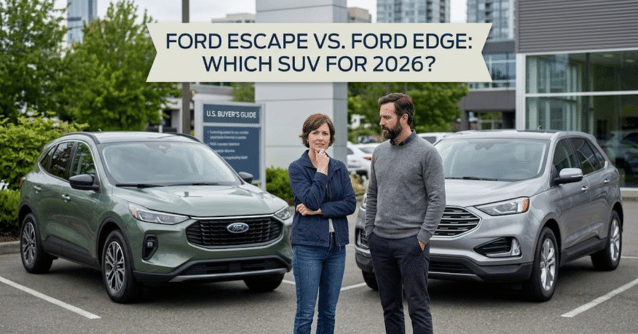
Choosing between these two Ford SUVs is less straightforward in 2026. The Ford Escape vs Ford Edge decision now includes availability, not only size and performance. The Escape remains available new, while Ford has discontinued Edge production.
The Escape suits buyers who prioritize efficiency, maneuverability, and several powertrain choices. The Edge remains attractive for shoppers wanting more cabin width, stronger standard performance, and a midsize SUV feel. Your best choice depends heavily on whether you want a new or used vehicle.
Quick answer: Choose the Escape for better fuel economy, easier parking, hybrid choices, and new-vehicle availability. Choose the Edge for a roomier cabin, stronger standard engine, and a more substantial highway feel. Most 2026 Edge shoppers will be considering used or certified pre-owned examples because Ford has ended production.
Ford Escape vs Ford Edge at a Glance
| Feature | 2026 Escape | 2024 Edge |
|---|---|---|
| Vehicle class | Compact SUV | Midsize SUV |
| Seating | 5 | 5 |
| Base engine | 1.5L turbo, 180 hp | 2.0L turbo, 250 hp |
| Stronger gas engine | 2.0L turbo, 250 hp | 2.7L turbo V6, 335 hp on ST |
| Hybrid available | Yes | No |
| Plug-in hybrid available | Yes | No |
| Maximum cargo space | Up to 65.4 cu. ft. | About 73.4 cu. ft. |
| Maximum towing | Up to 3,500 lbs. | Up to 3,500 lbs. when properly equipped |
| AWD | Available | Standard on later models |
| New-car status | Available for 2026 | Discontinued |
| Best fit | Commuting and efficiency | Space and highway comfort |
The table highlights an important difference beyond dimensions. One model remains a current new-vehicle choice, while the other primarily serves the used market. That distinction can affect financing, warranty coverage, selection, and long-term ownership decisions.
Which SUV Is Bigger?
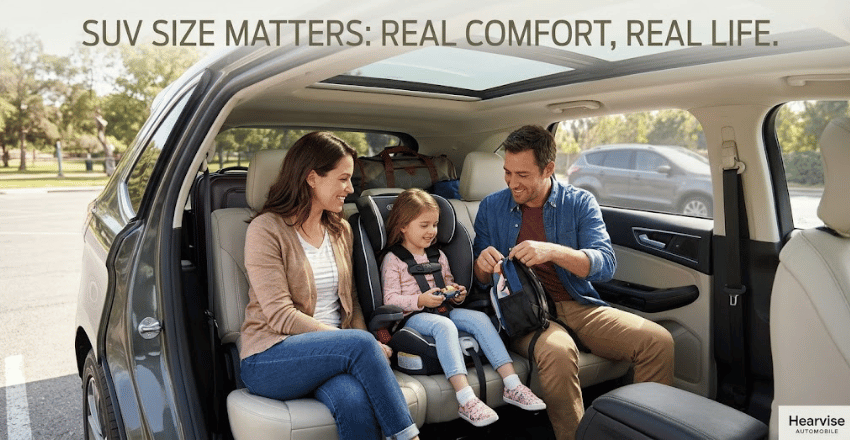
The Edge is noticeably larger. A 2024 model measures about 188.8 inches long, while the 2026 Escape measures about 180.1 inches. The longer wheelbase also gives the midsize SUV a broader, more substantial road presence.
That extra size helps when adults regularly occupy the second row. Shoulder room becomes especially valuable when three passengers sit across the rear bench. Families carrying child seats and luggage may also appreciate the wider cabin.
The Escape remains surprisingly spacious for a compact crossover. It offers up to 40.7 inches of second-row legroom with certain configurations. Its smaller exterior can still make daily parking and garage use much easier.
For more automotive content, readers can browse Hearvise’s Automobile section. The category covers vehicle-related topics and ownership information. It also provides a natural starting point for future car comparisons.
Cargo Space: Does the Edge Hold More?
The Edge has the advantage when maximum cargo capacity matters. Ford lists roughly 73.4 cubic feet behind the first row for the final generation. That makes it more suitable for larger household loads and road-trip equipment.
The Escape provides up to 65.4 cubic feet in EcoBoost configurations. Hybrid versions provide slightly less cargo capacity because of their powertrain packaging. Even so, that space should comfortably cover groceries, luggage, and routine family use.
The difference becomes more meaningful during larger trips. Bulky strollers, camping equipment, sports bags, and airport luggage can quickly use available space. Buyers who haul those items every week may benefit more from the larger model.
Engines and Performance
The Escape offers greater powertrain variety. Its 1.5-liter turbocharged engine produces 180 horsepower, while the available 2.0-liter engine produces 250 horsepower. Hybrid and plug-in hybrid choices broaden the lineup further.
The Edge starts from a stronger performance position. Its 2.0-liter turbocharged four-cylinder produces 250 horsepower in later model years. The performance-focused ST uses a 2.7-liter twin-turbo V6 producing 335 horsepower.
That difference matters if acceleration and effortless highway passing rank highly. The larger SUV suits drivers who want stronger standard output. The smaller crossover counters with greater flexibility and lower fuel consumption.
Performance enthusiasts can also read Hearvise’s 2012 Chevrolet Camaro ZL1 overview. That article examines a different type of American performance vehicle. It provides useful context on horsepower, engineering, and performance-focused design.
Fuel Economy Favors the Escape
Fuel efficiency is one of the Escape’s strongest advantages. Ford rates the 1.5-liter front-wheel-drive model at an EPA-estimated 27 city and 34 highway mpg. The available hybrid reaches an estimated 42 city and 36 highway mpg.
Later Edge models consume more fuel because they are larger and heavier. The common 2.0-liter turbo configuration is rated around 21 city and 28 highway mpg. Real-world results still depend on speed, weather, loading, and driving style.
The difference can become meaningful for high-mileage commuters. Saving several gallons each month can reduce long-term operating costs. Hybrid buyers gain an even larger efficiency advantage during stop-and-go driving.
Towing Capacity Is Closer Than You Might Expect
Size alone does not give the Edge an automatic towing victory. A properly equipped 2026 Escape with the 2.0-liter EcoBoost can tow up to 3,500 pounds. The correct factory towing equipment is required to reach that rating.
Properly equipped Edge models can also reach a 3,500-pound maximum. Exact capability depends on engine, equipment, passengers, and cargo. Buyers should always verify the specific vehicle’s rating before attaching a trailer.
The Escape therefore offers impressive towing capacity for its footprint. That can suit small campers, utility trailers, or certain recreational loads. Frequent heavy towing may still favor a larger vehicle with greater overall mass.
Escape Pros and Cons
Pros
* Better fuel economy. * Hybrid and plug-in hybrid choices. * Easier to maneuver and park. * Available as a new 2026 vehicle. * Up to 3,500 pounds of towing when properly equipped. * Lower starting price than the final new Edge.
Cons
* Less maximum cargo room. * Narrower cabin. * Base engine produces less power. * Some trims can become expensive. * 2026 availability has state restrictions.
The 2026 Escape has one unusual limitation for American buyers. Ford says it cannot be purchased for registration in California, Massachusetts, Oregon, New York, Washington, or Vermont. The restriction relates to 2026 emissions certification requirements.
That issue makes location important before you shop. Buyers in affected states will need a different model or model year. Shoppers elsewhere can still search participating Ford dealers for 2026 inventory.
Edge Pros and Cons
Pros
* Larger passenger compartment. * More maximum cargo space. * Strong 250-horsepower standard engine. * Available 335-horsepower ST. * Comfortable dimensions for frequent highway travel. * Standard AWD on later models.
Cons
* Production has ended. * No hybrid or plug-in hybrid option. * Lower fuel economy. * Larger exterior is harder to park. * Most buyers now need used or CPO inventory.
Discontinuation changes the buying equation significantly. Ford’s official website now describes the Edge as discontinued and directs customers toward other vehicles. Used examples remain widely relevant because millions were produced across many model years.
A used Edge can still represent strong value. Depreciation may put well-equipped trims within reach of compact-SUV shoppers. Buyers should compare mileage, service records, accident history, tires, and remaining warranty coverage.
Which Is Better for Families?
Family buyers should start by considering how often every seat gets used. The Edge’s wider cabin provides more breathing room when several passengers travel together. Its cargo advantage also helps during vacations and larger shopping trips.
The Escape works well for smaller households and everyday school runs. Rear legroom remains competitive despite its shorter exterior length. Its compact dimensions also reduce stress in crowded parking lots.
Child-seat users should test their own seats before purchasing either vehicle. Seat dimensions never tell the complete story about installation comfort. Rear-facing seats can change how much front-passenger room remains available.
Which Is Better for Commuting?
Most commuters will find the Escape easier to justify. It uses less fuel, occupies less parking space, and offers electrified powertrains. Those advantages become more valuable with frequent city mileage.
The Edge can make sense for longer highway trips. Its larger body and stronger base engine create a more substantial driving experience. The extra cabin room can also benefit carpooling or regular business travel.
A buyer driving mostly alone rarely needs maximum cargo capacity. In that situation, paying for extra size may provide little daily benefit. The smaller model usually offers the stronger efficiency-to-utility balance.
New Escape or Used Edge: The 2026 Buying Question
This is the comparison many U.S. shoppers now face. Ford currently lists the 2026 Escape with a starting MSRP of \$30,350. Edge buyers will usually compare used or certified pre-owned vehicles instead.
A new vehicle brings predictable history and full new-car warranty coverage. Used vehicles may provide more equipment for the same purchase price. Financing rates can also differ significantly between new and used inventory.
Don’t compare sticker prices without considering the complete ownership picture. Check insurance quotes, expected fuel use, warranty coverage, tire replacement costs, and financing. Those numbers can change which vehicle offers better value.
Hearvise readers interested in another midsize SUV can also explore the site’s 2016 Lexus RX 350 review. The Lexus takes a more luxury-focused approach to the segment. Comparing several vehicle types can help clarify which features matter most.
Our Verdict: Which Ford SUV Should You Choose?
For most U.S. shoppers seeking a new vehicle in 2026, the Escape is the practical choice. It provides multiple engines, strong efficiency, useful interior space, and current new-car availability. Its smaller footprint also suits everyday commuting better.
Choose a used Edge when space and stronger performance matter more than fuel economy. It remains appealing for families that frequently carry passengers and luggage. The ST is especially interesting for buyers who want much more power.
The final Ford Escape vs Ford Edge verdict therefore depends on your buying route. Choose the Escape for a new, efficient compact SUV. Choose the Edge when a larger used midsize SUV better fits your routine.
Before deciding, compare real local listings and drive both vehicles. Seat comfort, visibility, cabin noise, and control layout can change your preference. A specification table cannot replace time behind the wheel.
Frequently Asked Questions
Is the Ford Edge bigger than the Escape?
Yes, the Edge is both longer and positioned in a larger vehicle class. It also provides greater maximum cargo capacity. The difference is most useful for families and frequent highway travelers.
Which gets better gas mileage?
The Escape wins clearly for fuel efficiency. Its gas models use less fuel than comparable late-model Edge versions. Hybrid and plug-in hybrid options increase that advantage further.
Which has more cargo space?
The Edge provides more maximum cargo capacity. Late models offer roughly 73.4 cubic feet with the rear seats folded. The 2026 Escape offers up to 65.4 cubic feet in EcoBoost configurations.
Which is better for towing?
Both can reach about 3,500 pounds when properly configured. The Escape requires the available 2.0-liter EcoBoost and appropriate towing equipment. Always confirm the exact rating for the vehicle you plan to buy.
Is the Ford Edge discontinued?
Yes, Ford officially describes the Edge as discontinued. The company continues to support existing vehicles and directs shoppers to other current models. Used and certified pre-owned Edge inventory remains available.
Is the Escape still available in 2026?
Yes, Ford currently offers a 2026 model in the United States. Registration restrictions apply in six states because of emissions certification requirements. Those states are California, Massachusetts, Oregon, New York, Washington, and Vermont.
Which is better in the Ford Escape vs. Ford Edge comparison?
The Escape is better for efficiency, commuting, and shoppers wanting a new vehicle. The Edge is better for greater cabin room and stronger standard performance. Your mileage, passenger needs, and new-versus-used preference should decide the winner.